
Last spring, I was walking through central Madrid, looking for somewhere to eat before my Spanish proficiency exam. On a small street, I passed a few restaurants whose entrances were easy to overlook. Approaching one of the windows, I noticed a plain white sheet of A4 paper. I expected opening hours. Instead, it announced the restaurant’s two Michelin stars, with the years listed beneath.
I walked away almost immediately, a little intimidated. This was clearly a different kind of lunch from the one I had in mind.
What stayed with me was how little the restaurant needed to say. There was no elaborate display or conspicuous attempt to attract my attention. That single piece of information had changed my reading of the entire place. Before seeing a menu, knowing the chef’s name or tasting anything, I had understood that I was standing outside somewhere distinguished—and had quietly decided it was beyond the scope of my afternoon.
I thought about it throughout lunch, which I eventually ate at Burger King.
There was something remarkable about the authority contained in that modest sheet of paper. An institution had assessed the restaurant and awarded it a distinction I recognised. I could approach the experience with an expectation of excellence, borrowing the judgement of people whose expertise I trusted. Whether I would personally enjoy it remained an unanswered question.
Similar systems help us navigate hotels, wines and other areas of luxury. Fashion, beauty and jewellery have their own awards, experts and institutions, although no single guide occupies quite the same position across those fields. In each case, recommendations coexist with reputation, personal knowledge and the influence of other people. How much authority does any one judgement hold over what we actually choose?
Around that time, I had also been noticing how frequently the word “taste” appeared in conversations about fashion: who possessed it, who supposedly lacked it, and whether the people traditionally entitled to define it still held that power.
That restaurant window gave those conversations a concrete form. A judgement had been made elsewhere, by people I would never meet, and it had shaped my behaviour within seconds. I wanted to understand how that authority is acquired, how it travels, and what happens when different voices begin to disagree about what deserves our desire.
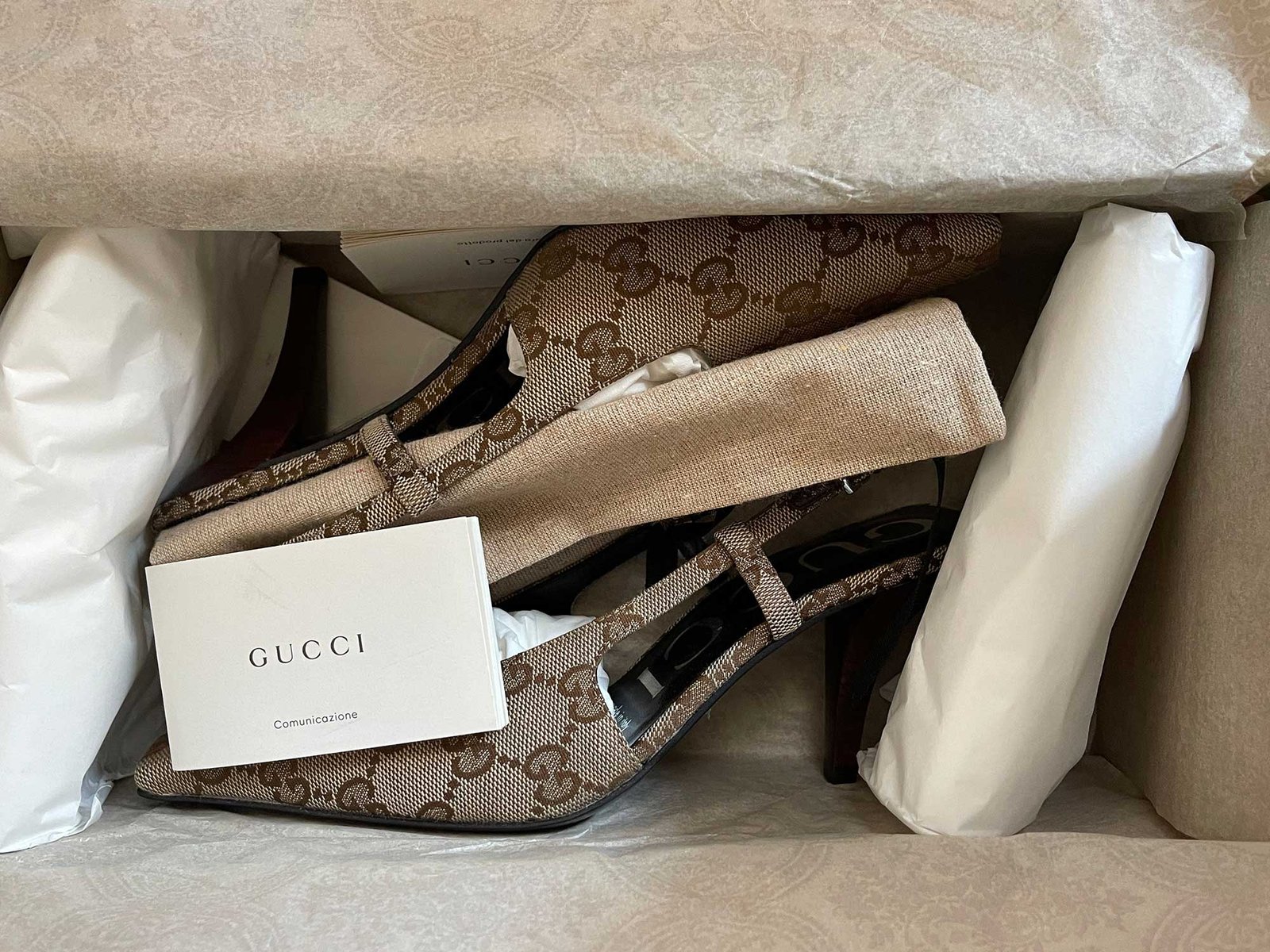
What Do We Mean By Taste?
Taste seems personal until we call it good.
To say that we like something is to describe a preference. To call it tasteful is to make a judgement that reaches beyond ourselves: an assertion about what deserves appreciation, and often about the people capable of appreciating it. The word moves almost imperceptibly between pleasure, discernment and social approval. We may agree that everyone has their own taste while remaining remarkably confident that some people’s taste is better than others’.
This tension has occupied thinkers for centuries. In his 1757 essay Of the Standard of Taste, David Hume observed how profoundly preferences differ, even among people raised within the same society. Yet he also argued that judgement could be cultivated through experience, comparison and attentive observation. Taste might begin with a feeling, but our ability to perceive and evaluate could develop.
The difficulty lies in separating what we have learned to notice from what we have learned to approve.
In Distinction, first published in 1979, the sociologist Pierre Bourdieu examined how aesthetic preferences are shaped by social conditions. Education, upbringing and familiarity with particular cultural worlds help form the judgements we experience as instinctive. What feels like an effortless eye may carry years of exposure behind it. Taste also establishes boundaries: when we describe something as refined, pretentious or vulgar, we reveal the standards through which we recognise—and distance ourselves from—others.
Luxury makes these distinctions especially visible. Access to the same objects does not produce agreement about their desirability. Two people of similar age, income and nationality might admire entirely different interiors, collect different artists or disagree about whether a heavily ornamented jewel is magnificent or excessive. Their apparent demographic similarity can conceal different family traditions, professional environments, reference points and aspirations.
Context changes the reading, too. Imagine the same extravagant necklace worn at a ceremonial celebration, a gallery opening and an informal lunch. Its materials and workmanship remain unchanged; its relationship with the occasion shifts. Judgements of taste concern the relationship between an object, its wearer, its setting and the people interpreting it.
Even discretion has no universal meaning. Research by Young Jee Han, Joseph C. Nunes and Xavier Drèze found that preferences for prominent or subtle luxury branding varied with consumers’ social signalling motives. Some valued goods recognisable to a narrow circle; others preferred more widely legible signs of status. These were different strategies of recognition, rather than successive stages on a single path towards refinement.
None of this makes craftsmanship, originality or informed judgement irrelevant. It asks us to distinguish an assessment of quality from the social authority attached to a particular aesthetic. A preference for restraint does not, by itself, demonstrate greater understanding than a love of colour, ornament or spectacle.
For luxury businesses, these questions have commercial consequences. Shared judgements help direct attention, confer legitimacy and make certain objects worth pursuing—and paying more for. A product must find people who appreciate its qualities, recognise its references or desire the associations it carries. Understanding taste therefore means understanding how personal preferences acquire collective force.
Which leads to a question with considerable economic weight: whose judgement becomes influential enough to shape everyone else’s?
Where authority lived
For much of the twentieth century, the authority to define taste in luxury was concentrated in a relatively small circle of houses, institutions and influential individuals. Their judgements travelled through collections, magazines, guidebooks and exhibitions, giving particular ideas of excellence the weight of established knowledge.
In fashion, the maison occupied a central position. Its authority rested on a recognisable creative vision, the expertise of its ateliers and the prestige of Paris. This model had taken shape in the nineteenth century with Charles Frederick Worth, who presented designs from which clients could choose, asserting the couturier’s position as an artist whose judgement deserved to be followed. The house offered an education in how to dress.
Yet even the most powerful designer needed interpreters. Fashion editors helped determine which proposals would become culturally significant, giving them visibility, language and context. When Christian Dior presented his first collection in 1947, it was Carmel Snow, editor-in-chief of Harper’s Bazaar, who supplied the phrase that would define it: the “New Look”. Dior created the silhouette; an editor helped establish how the world would understand it.
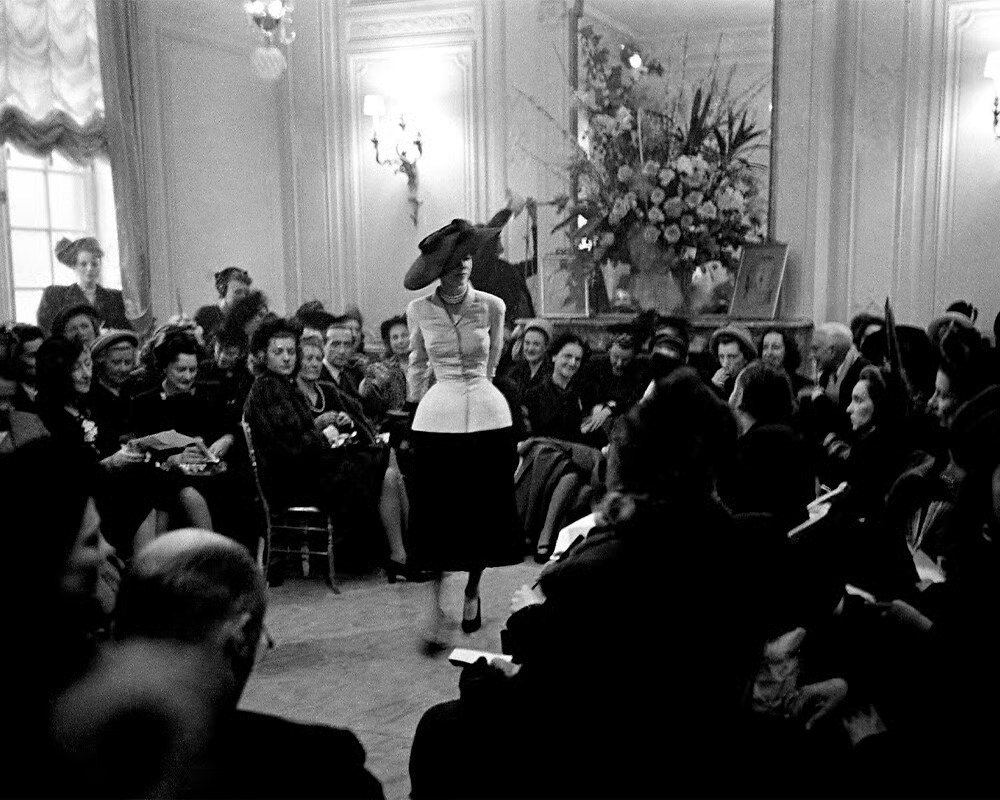

“My dear Christian, your dresses have such a New Look!”
Carmel Snow, Editor-in-Chief, Harper’s Bazaar 1947
Source: dior.com
The relationship is revealing. Taste already emerged through an exchange between creators, commercial interests, influential clients and the press. What distinguished this system was the concentration of authority among people whose positions gave their preferences exceptional reach.
Beyond fashion, that authority often took the form of a recommendation or a ranking.
For restaurants, the Michelin Guide made expert judgement portable. It began awarding dining stars in 1926 and introduced its hierarchy of one, two and three stars in 1931. Anonymous inspection gave the recommendation an institutional voice: a restaurant’s excellence could be assessed, classified and communicated to people who had never eaten there. The guide supplied travellers with a framework for deciding what deserved their attention.
Hotels acquired similar systems of recognition. In the United States, the Mobil Travel Guide, launched in 1958, introduced its five-star hospitality ratings in 1960. Such guides made unfamiliar establishments easier to judge before arrival. Their evaluations offered reassurance, while the distinction itself became something hotels could build their reputations around.
These systems answered a question of standards. The more socially delicate question—where one ought to be seen—could still depend on the company one kept. A technically excellent hotel or restaurant and a fashionable address were not necessarily the same thing. Choosing well involved understanding both kinds of recognition.
In wine, authority could become so firmly established that it outlived the circumstances that produced it. Bordeaux’s 1855 classification formalised a hierarchy rooted in the trade’s accumulated knowledge and the prices estates had historically commanded. Brokers and merchants helped turn an existing commercial order into an enduring reference for quality and prestige. The market was already participating in the definition of taste, and the classification gave that judgement institutional permanence.
Art exposes the tensions within this process particularly clearly. In nineteenth-century France, the Paris Salon’s jury controlled access to an exhibition whose approval could help secure an artist’s reputation and wealthy patrons’ commissions. Its preference for established subjects and conventions made it a powerful guardian of artistic legitimacy.
But authority could also be challenged by someone willing to invest in another judgement. The dealer Paul Durand-Ruel supported the Impressionists while they were still widely dismissed, buying their work, organising exhibitions and cultivating an international audience. He helped create the conditions in which an initially controversial aesthetic could become desirable. Recognition required conviction, money, distribution and time.
I’ve selected these examples to illustrate the article, and they belong largely to the European and North American institutions that helped shape the international luxury market. But their influence should not be mistaken for a universal history of taste. Other cultures sustained their own traditions of patronage, connoisseurship and aesthetic authority.
Even within this narrower history, however, the past was never governed by a single, uncontested voice. Houses competed, critics disagreed and patrons backed work that institutions rejected. The hierarchy was more legible than absolute: people knew which names, publications and distinctions carried weight.
For the consumer, those authorities offered a valuable shortcut. One could borrow the judgement of a couturier, an inspector, a merchant or a dealer while developing one’s own. Their power lay in making a particular choice feel credible. And in establishing the references against which subsequent choices would be judged.
A more crowded conversation
The established authorities have not disappeared. Fashion houses still command attention, critics still influence reputations, and institutional recognition still carries weight. But they now operate within a conversation whose participants can answer back, redirect attention and make unexpected things desirable.
At the same time, commercial power remains highly concentrated. Groups such as LVMH and Kering possess the resources to give a creative proposal extraordinary visibility through stores, advertising, cultural partnerships and global distribution. Their own reporting places desirability alongside product strategy, retail investment and financial performance. A collection may express a designer’s vision, but the conditions under which that vision reaches the public are also business decisions.
This creates a tension at the heart of contemporary luxury. Houses need a distinctive point of view to justify their authority, while their commercial scale demands that enough people recognise—and purchase—that distinction. Creative independence operates within an organisation with expectations about growth, profitability and the audience it intends to reach.
The audience, meanwhile, has acquired its own means of circulation. Consumers can publish their wardrobes, explain references, compare workmanship and build communities around an enthusiasm that once might have remained private. A convincing interpretation can travel beyond the institution that first introduced the object. The house supplies a proposal; its meaning continues to develop through the people who wear, discuss and reinterpret it.
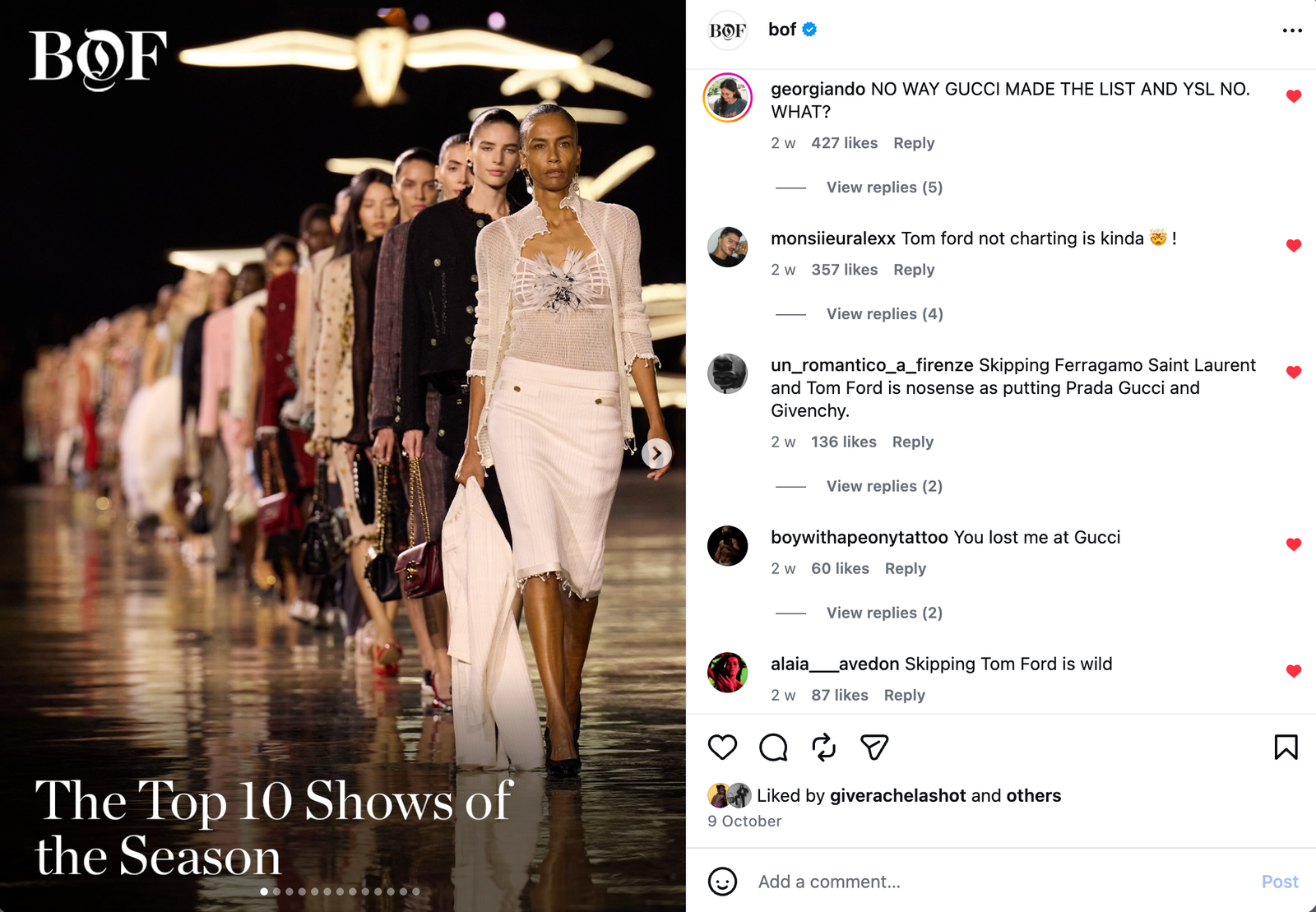
600 + comments on Business of Fashion’s staff picks for best SS 2027 shows, predominantly critical. Source, BoF Instagram
The rise of “quiet luxury” illustrates this process. Understated clothing and discreet signals of wealth existed long before the phrase became a widespread preoccupation. What changed was their visibility as a named, shareable aesthetic, amplified by entertainment, commentary and shopping. In its review of 2023, Lyst reported that searches for Loro Piana’s baseball cap increased by 95% following the release of Succession’s final season. A costume choice became a reference point through which audiences discussed wealth—and sought products associated with it.
Calling this taste “crowdsourced”, however, leaves out an influential participant: the platform.
Feeds organise attention according to systems that interpret behaviour. TikTok describes recommendations informed by signals including viewing time, likes, shares and comments.
The cultural implication is a feedback loop: people respond to what they encounter, and those responses help determine what circulates next.
A preference that feels spontaneous may develop through repeated exposure, while a highly visible aesthetic can appear more universally admired than it is.
Within this environment, celebrities, stylists and influential creators act as interpreters whose authority comes partly from their ability to make a choice feel personally convincing. Their influence becomes especially visible when attention turns into measurable demand. The RealReal reported that searches for “Celine Flare Jeans” rose by 963% within 24 hours of Kendrick Lamar’s 2025 Super Bowl performance. The figure describes activity on one platform, but it offers a striking example of how quickly a public appearance can redirect interest towards a specific object.
Such moments do not automatically establish lasting taste. They demonstrate the power to initiate desire. Whether that desire survives repetition, wider availability or the next cultural event is another question.
The secondary market makes that question unusually visible. Resale platforms allow consumers to compare what objects retain value, which designs return to favour and which creative periods attract renewed interest. In its 2026 report, The RealReal recorded sharp increases in saved searches for work associated with particular designer-house relationships, including Phoebe Philo’s Céline and Nicolas Ghesquière’s Balenciaga. Here, appreciation attaches to a specific body of work, rather than extending indiscriminately to everything bearing the same label.
Collectors and resale businesses consequently participate in a continuing reassessment of the archive. Their selections and transactions help keep certain objects culturally present after the original campaign has ended. Prices provide one signal of that interest, although scarcity, condition and speculation also affect what an object commands. Market value can reveal desire without settling a judgement of taste.
Alongside this public circulation of approval sits a desire for greater privacy, specificity and substance. Research published by BCG and Altagamma in 2025 found that 89% of surveyed top-tier luxury clients identified craftsmanship and product quality as leading drivers of value, while 80% expressed a preference for exclusive, dedicated spaces offering privacy and attentive service. These findings suggest the importance of experiences and qualities that mass visibility alone cannot provide.
Knowledge can itself become a distinction: recognising a particular weave, understanding a maker’s technique or choosing an object for a history that requires explanation. As the earlier discussion of taste suggests, this is a familiar social mechanism operating within new conditions. Discretion can communicate belonging just as effectively as a conspicuous emblem, provided the intended audience understands it.
The resulting landscape is uneven. Participation has widened, while the ability to finance production, organise visibility and convert attention into sales remains unequally distributed. A house, a stylist, a collector and an online community may all influence the same object’s desirability, each bringing a different kind of authority.
For luxury brands, proposing a convincing world therefore remains essential. What has become harder is controlling everything that world will mean once other people begin to inhabit it.
The Authority to Propose, the Power to Decide
Taste has always involved negotiation: between creators and clients, institutions and outsiders, personal pleasure and the desire to belong. What has changed is the scale, speed and visibility of that exchange. More people can participate, more judgements circulate, and the distance between an individual preference and a commercial opportunity has become remarkably short.
Yet wider participation has given us no universal agreement about what deserves admiration. Luxury contains overlapping worlds, each with its own references, ambitions and standards. The same object can signify confidence in one circle, conformity in another and nothing at all to someone unfamiliar with its codes. Any claim to “good taste” carries an implicit question: good according to whom?
For brands, this makes cultural understanding essential. Responding to every visible preference risks producing something interchangeable, while assuming that heritage or prestige guarantees agreement mistakes authority for immunity. A convincing creative position requires both conviction and an awareness of the people who will interpret it. There must be something worth recognising, and enough depth to reward a closer look.
Perhaps the most influential position belongs to those who can recognise an emerging sensibility and give it a compelling form before it becomes familiar. Their judgement helps others articulate a preference they had not yet found the language to express.
Luxury businesses have considerable resources with which to make that proposal. Whether it becomes meaningful, desirable or enduring depends on what happens after it leaves their hands.
I keep returning to that restaurant window in Madrid. A plain sheet of paper had communicated enough for me to recognise the place as distinguished before I knew anything about its cooking. That is considerable authority. But recognising its distinction had not made me want to walk inside. My appetite, my plans and the circumstances of that afternoon still had their say.
Perhaps that small encounter captures the relationship between authority and choice. An institution can establish a reputation; a brand can make a compelling proposal; other people can teach us what to notice. What we do with those judgements remains a more personal negotiation. That afternoon, two Michelin stars held their prestige, and I went to Burger King.