On a recent visit to the museum at Turku Castle in Finland, a display of games used centuries ago by the royal families who inhabited the castle throughout its long history caught my attention. The museum explained that the particular examples on display had been used by wealthy and powerful families at their summer residences—places they would retreat to during the warmer months to rest, entertain and, quite literally, play.
Earlier that same day, I had been chatting with our partners at Sereia about Victoria Beckham Beauty’s Portofino ’97 playing cards, and about how something so universal and simple could be transformed into a luxurious object capable of sparking desire.
I had already begun noticing how many leading fashion and lifestyle brands were producing and marketing classic games as precious, desirable objects, and I found myself wondering whether this had become more prevalent lately or whether I had simply started paying closer attention. Seeing those centuries-old games at the museum made me even more curious about the historical relationship between luxury and these seemingly timeless forms of entertainment.
The truth is, luxury houses have been making playing cards, chess sets, backgammon boards, poker sets and other objets de loisir for decades. What feels contemporary is seeing far more brands outside the traditional luxury-home category turn games into relatively accessible, highly art-directed pieces of brand storytelling.
Games have belonged to the luxury world for a long time
Historically, games have long been associated with aristocratic and upper-class leisure: card rooms, chess, bridge, mahjong, backgammon, country houses, private clubs, casinos, ocean liners and resorts. They belong to that entire universe of having enough leisure to turn passing time into ritual.
There is a wonderful little historical clue from 1973. A British newspaper article covering the enormous backgammon revival at the time reported that Asprey was experiencing significant demand and described its buyers as the fashionable “bright young set.” The article also noted backgammon’s established presence at elite London clubs such as White’s and the Clermont.
So when a luxury house creates a beautiful backgammon set, it isn’t really doing the equivalent of putting its logo on Monopoly. It is tapping into an existing code of leisure.
Hermès is a perfect example. Games are hardly a recent novelty category for the house. Its home collections have long included chess, dominoes, mahjong and backgammon. The Samarcande chess pieces, for instance, date back to a 2009 design, and contemporary versions are approached with the same attention to materials and craftsmanship as the rest of the maison’s métiers: leather marquetry, hand-carved woods and details derived from its equestrian and saddlery heritage.
Its current Atout d’Hermès games table takes the idea almost absurdly far: leather-marquetry playing surfaces for chess, checkers and backgammon, accompanied by equipment for bridge, tarot, poker and dice. Its price? €121,000.
At that point, the game is no longer merchandise. It is furniture for the Hermès universe.
Louis Vuitton makes the connection even clearer
Louis Vuitton’s historical proposition could essentially be summarized as this: we make the objects that accompany the life of an affluent traveller.
The maison has therefore always been unusually well positioned to create specialized trunks and cases. Its archives contain everything from the bed trunk of the 1880s to the extraordinary travelling secretary created for conductor Leopold Stokowski in 1929.
Games fit beautifully into that tradition.
One particularly extravagant example is the 2009 Louis Vuitton Casino Trunk, created for the opening of the maison’s Macau store. It contained a roulette wheel, 20 packs of playing cards and 800 poker chips. One sold at Christie’s in 2024 for €75,600.
Today, Louis Vuitton sells everything from a €12,000 Monogram poker case containing 300 ceramic chips and two decks of cards to an enormous €90,000 leather games table designed for backgammon, chess, xiangqi, mahjong and cards.
There is, then, very real historical continuity here. The forms may evolve, but the proposition remains remarkably familiar: luxury creating beautifully crafted objects for the rituals of leisure.
Ralph Lauren is another fascinating case
Ralph Lauren’s entire project has arguably always gone beyond clothing into lifestyle world-building. Consequently, a chessboard or poker set almost makes more conceptual sense for Ralph Lauren than another sweater.
Its game offering currently spans a $45 Double RL deck of cards all the way to the $6,995 Sutton five-game set in walnut and leather and even a $9,995 mahjong set.
My current favourite, however, is the $50 Ralph’s Coffee Matching Game, which represents something slightly different.
It isn’t primarily an artisanal luxury object like the examples mentioned before. Instead, it is a tiny piece of the Ralph Lauren imaginary that you can take home.
And that is where I think the current phenomenon gets particularly interesting.
From luxury object to brand media
There has essentially been a democratization of the luxury objet.
Traditionally, a branded game from a luxury house might have been a £5,000 backgammon board sitting in the Home department alongside crystal, silverware and cashmere blankets. Increasingly, however, we are seeing the €40–€150 game functioning as brand media.
Victoria Beckham Beauty’s Portofino ’97 playing cards are an almost comically perfect example. They cost $75, yet the product’s presentation barely concerns itself with playing cards. Instead, the object becomes part of a fantasy: Portofino, poolside afternoons, conversation, romance, summer, lingering time. The cards belong to a capsule built around the memory of Victoria and David Beckham’s secret trip to Portofino in 1997.
In other words, the product is a deck of playing cards. The thing being sold is Portofino ’97.
That is sophisticated brand-world building.
Games also possess a combination of characteristics that makes them unusually useful to brands right now.
They’re inherently social. You physically interact with the brand alongside other people rather than merely displaying it.
They’re analogue. In an overwhelmingly digital culture, cards, puzzles, mahjong and chess offer tactile pleasure.
They’re decorative. A beautiful chessboard or backgammon set can live permanently on a coffee table.
They’re giftable. They offer a much easier entry point into a brand universe than a €3,000 handbag.
They’re extremely brandable. Every card, piece, box and board becomes a graphic-design surface.
They imply leisure. And leisure itself remains one of luxury’s oldest codes.
There is also something deliciously counterproductive about them. You don’t need a $75 Victoria Beckham deck of cards. A €4 deck performs precisely the same function.
Which makes the luxury version an almost textbook example of transforming utility into desire through culture, aesthetics, narrative and symbolism.
Logging off is becoming a luxury of its own
There is another reason why games feel particularly relevant now.
After years in which seemingly every part of everyday life became digitised, there is an increasingly visible desire to reclaim activities that require no screen at all. Reading physical books, keeping handwritten journals, shooting film, knitting, painting, doing puzzles, playing cards or sitting around a table for a game of backgammon can all become small acts of opting out.
The attraction isn’t necessarily a wholesale rejection of technology. Most of us have neither the desire nor the practical ability to abandon digital life. Rather, it is the luxury of being able to disconnect from it deliberately.
And that distinction matters.
Constant connectivity was once a status symbol. Having the newest device, being reachable everywhere and having immediate access to information all signalled participation in a new technological world. Today, being able to put the phone away for an afternoon can feel more aspirational.
Uninterrupted time itself has become scarce.
In that context, analogue leisure acquires a different kind of value. A beautifully made deck of cards or backgammon board promises something beyond the object: an evening around a table, a long afternoon on holiday, conversation without notifications, concentration without a screen.
Traditional games are especially well suited to this narrative because they already carry the weight of history. Chess, cards, backgammon and mahjong evoke rituals that existed long before smartphones—or, in many cases, long before modern luxury houses themselves. They suggest continuity, heritage and traditions passed between generations.
Add exceptional materials and beautiful design, and the object becomes desirable. Add the codes of a major luxury name, and it becomes part of a much larger fantasy.
For luxury consumers increasingly interested in craftsmanship, heritage, ritual and experiences that feel removed from mass digital culture, the humble game suddenly makes extraordinary sense.
Not all games speak the same language
Games aren’t culturally coded in quite the same way, either. Each carries its own accumulated associations, making the choice of game itself part of the brand message.
Chess → intellect, strategy, old-world interiors, masculinity, clubs.
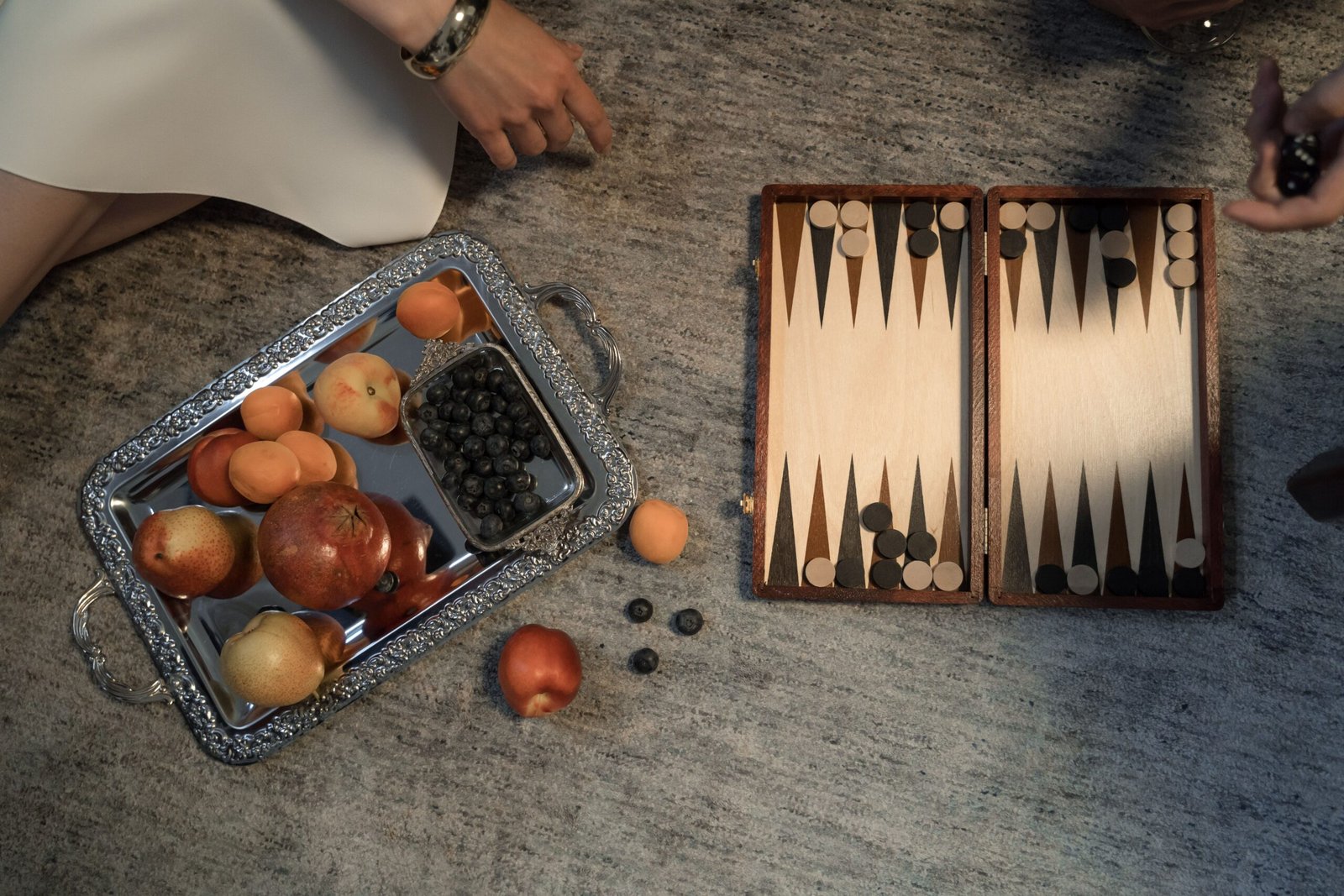
Backgammon → Mediterranean leisure, resorts, jet-set culture, 1970s glamour.
Playing cards / bridge → clubs, hotels, travel, society.
Poker → casino culture, masculine glamour, risk.
Mahjong → enormously rich Asian cultural associations, family and social ritual, increasingly interpreted by Western luxury brands.
Puzzles → domesticity, slow living, art and design culture.
Children’s games → family, inheritance, and the introduction of a brand universe to another generation.
That last category makes the Ralph’s Coffee Matching Game particularly interesting. A child doesn’t need to understand Ralph Lauren as fashion. They are simply playing with Ralph’s Coffee iconography.
It is, in a sense, brand transmission disguised as play.
Tiffany & Co. provides another useful piece of the puzzle. Its games category includes a Tiffany Blue leather backgammon set priced at $9,350, while its history of extraordinary decorative objects includes a sterling-silver-and-gold chess set that reportedly required more than 260 hours of artisan work.
Once again, the object exists somewhere between game, decorative art, craftsmanship and brand mythology.
Luxury has always known how to play
So perhaps fashion and lifestyle brands haven’t suddenly discovered games after all.
What has changed is the role these objects can play within a contemporary brand universe.
At one end of the spectrum remains the spectacular luxury object: the €121,000 Hermès games table, the Louis Vuitton casino trunk, the Tiffany backgammon set. These pieces belong to a centuries-old tradition of wealthy patrons commissioning exquisitely made objects for their leisure.
At the other is something much smaller and more accessible: a beautifully art-directed deck of cards, a puzzle or a children’s memory game. It may cost a fraction of a handbag, but it can communicate an entire world.
And perhaps that is why games feel so particularly relevant to luxury right now. They sit at the intersection of so many things the industry is currently interested in: heritage, craftsmanship, analogue pleasure, hospitality, travel, nostalgia, ritual and the construction of complete lifestyle universes around brands.
Centuries ago, wealthy families brought games to their summer residences to fill long afternoons with play. Today, a deck of Portofino ’97 cards can evoke almost exactly the same fantasy: somewhere beautiful, plenty of time, good company, and nowhere more important to be.