Luxury is simultaneously a cultural concept, an economic category, and a global industry with its own codes and dynamics. While a high price can be manufactured overnight, true luxury requires cultural authority, emotional resonance, exceptional execution, and the ability to sustain desire over time
The word luxury appears endlessly across media headlines, campaign taglines, and digital feeds. It is routinely attached to boutique hotels, rare watch movements, high fashion collections, and bespoke perfumes. Yet we rarely stop to examine what granting an object or experience “luxurious” status actually demands.
Is luxury defined simply by what costs more? Does it hinge entirely on artificial scarcity? Or is there a deeper framework that explains why certain houses maintain an untouchable aura generation after generation, while others fade as quickly as they arrive?

The Meaning of the Word Luxury
Traditional dictionary definitions often categorize luxury as demasía, indulgence, or non-essential abundance. While this reflects an era when luxury was tied primarily to ostentatious display, it fails to capture the modern luxury landscape.
The very concept of what luxury means has, in fact, transformed dramatically across centuries—shifting from sacred royal rituals in antiquity to aristocratic status symbols, and later to industrial exclusivity. (We explore this rich evolution in detail in our piece, Has Luxury Always Existed? A Brief History of Luxury from Antiquity to the Present Day). However, while historical luxury was long anchored in divine right or conspicuous excess, contemporary luxury operates on a fundamentally different paradigm.
Today, luxury is defined less by accumulation and excess, and far more by restraint, intentionality, and quiet mastery. The great contemporary maisons do not construct their desirability through volume; they build it through four core pillars.
Four Pillars of Contemporary Luxury
Beyond its linguistic definition, luxury constitutes a perfectly identifiable category within the global economy. It is a segment comprised of companies whose value proposition does not primarily compete on price or functionality, but rather on intangible attributes that generate desire.
Although no universal formula determines whether a brand qualifies as luxury, four recurring principles help explain how luxury value is created and sustained.
1. Craftsmanship Over Scalability (The Obsession with Detail)
Mass-premium brands tend to prioritize speed, uniformity, and volume. Luxury follows a more exacting logic, placing technique, material quality, human mastery, and the patience of time at the center of its value. The internal frame of Louis Vuitton is built from 30-year-old dried poplar wood aged for several years. Chanel artisans use the Luneville crochet hook method to apply thousands of sequins and beads by hand to haute couture garments.
A product becomes luxurious when its creation involves unrepeatable skill and an uncompromising selection of raw materials.
Atelier Note: > In luxury branding, value is often communicated through details that appear almost invisible: the tactile weight of a packaging box as it closes, the texture of custom-milled paper, or the carefully composed atmosphere of a physical space.
2. Cultural Significance & Narrative Heritage
When an individual acquires a Rolls-Royce Phantom Series II, they are not buying raw function. They are participating in a mythology, a heritage, and a world vision.
Luxury items are not merely commodities; they are cultural symbols. Great luxury houses curate culture. Ralph Lauren’s two-decade partnership with Wimbledon has been so effective that the brand has become part of the championship’s visual identity.
3. Sensory Experience and Ritual
Luxury exists beyond the digital screen. It is deeply sensory. From the scent of a boutique lobby to the weight of a physical monograph or the subtle tactile resistance of a display case, luxury requires an intimate harmony between the physical environment and the brand’s visual identity. The Gucci Salon Concept offers private, apartment-style retail spaces featuring rare art, personal butlers, and custom meals for top clients while Porsche Experience Centers are track-driving facilities allowing enthusiasts to feel the brand’s mechanical performance firsthand.
4. Scarcity, Mystery & The Unhurried Pace of Time
While mass-market retail relies on urgency and instant gratification (“Buy now”), luxury cultivates patience, mystery, and anticipation. Scarcity in luxury is not merely an inventory trick; it reflects the physical limits of unhurried production and dedicated artistry. High-demand Rolex models like the Daytona or Submariner face multi-year dealer waiting lists despite steady manufacturing while Patek Philippe‘s Grandmaster Chime requires application approval for buyers.
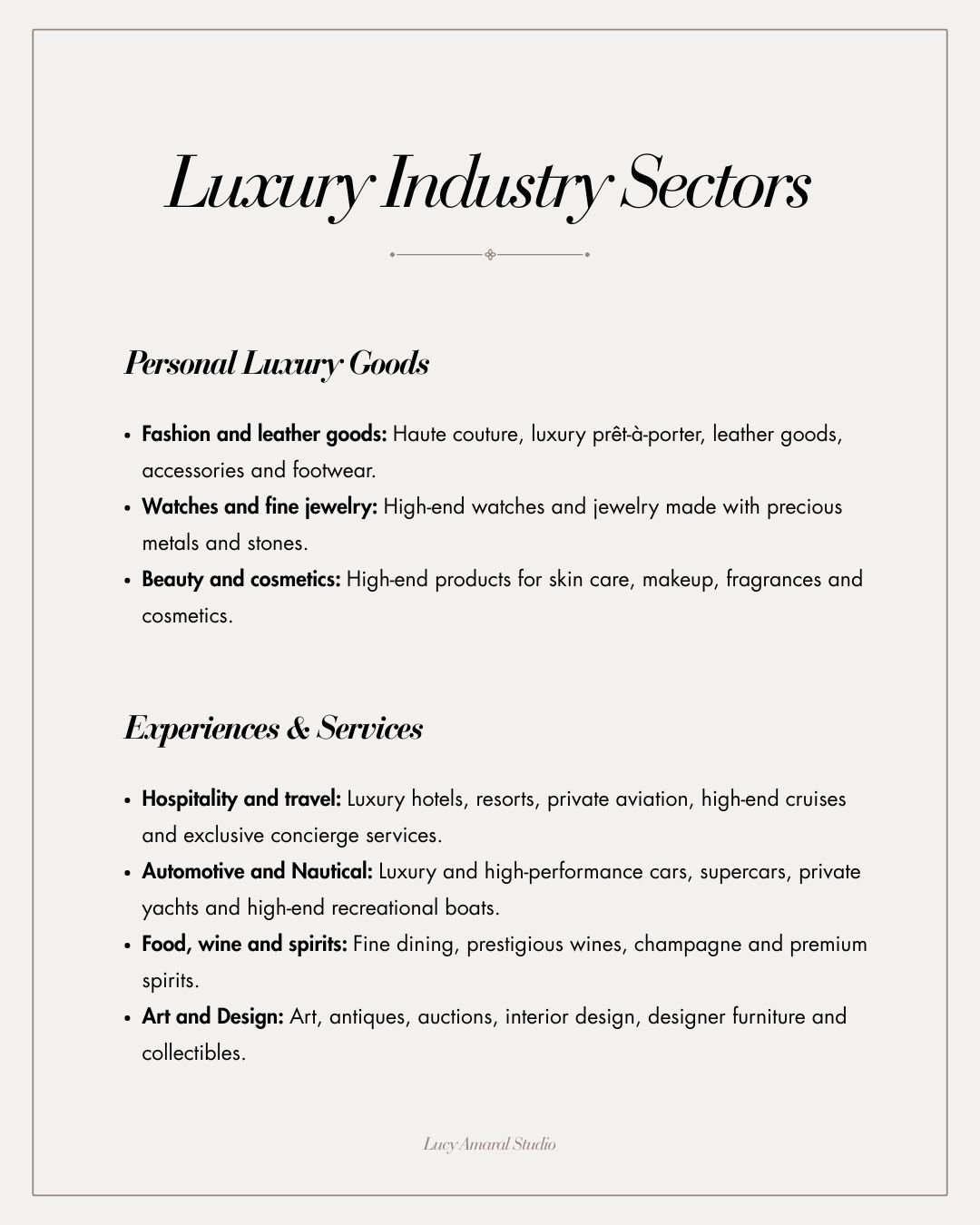
The Sectors in the Luxury Industry
It bears mentioning that, when we talk about the luxury industry, we’re referring to a much broader ecosystem than just fashion. Although each responds to different dynamics, the industry’s sectors all share the same objective: to offer an exceptional level of product, service, and experience that justifies a clearly differentiated position within the market.
The New Meaning of Luxury
Perhaps the most profound change the sector is experiencing has to do with the very idea of wealth. For much of the 20th century, luxury functioned as a visible demonstration of economic success. Today, that aspirational dimension still exists, but it increasingly shares space with a search for personal experiences, well-being, time, authenticity, and meaning.
Several reports published in recent years by consulting firms such as McKinsey & Company and The Business of Fashion point precisely in this direction. For many consumers, the emotional connection with a brand has become as important a decision-making factor as product quality or the company’s historical prestige.
While the 4 pillars of luxury remain essential for a brand to be qualified as such, they are no longer sufficient on their own. New generations of consumers also expect authenticity, responsibility, innovation, and a much deeper emotional connection with brands.
The Strategic Perspective: Intangible Value in a Quantitative World
Reducing luxury to price is to oversimplify an extraordinarily complex phenomenon. And for founders and brand directors, understanding luxury is a strategic discipline. The economic power of luxury lies in creating value that extends far beyond material cost and functional utility.
Achieving this requires a dual-track approach: marrying poetic visual narrative with sharp market strategy. When aesthetic excellence and strategic discipline operate in alignment, a brand becomes less vulnerable to conventional price competition and begins to build enduring prestige.
Further reading