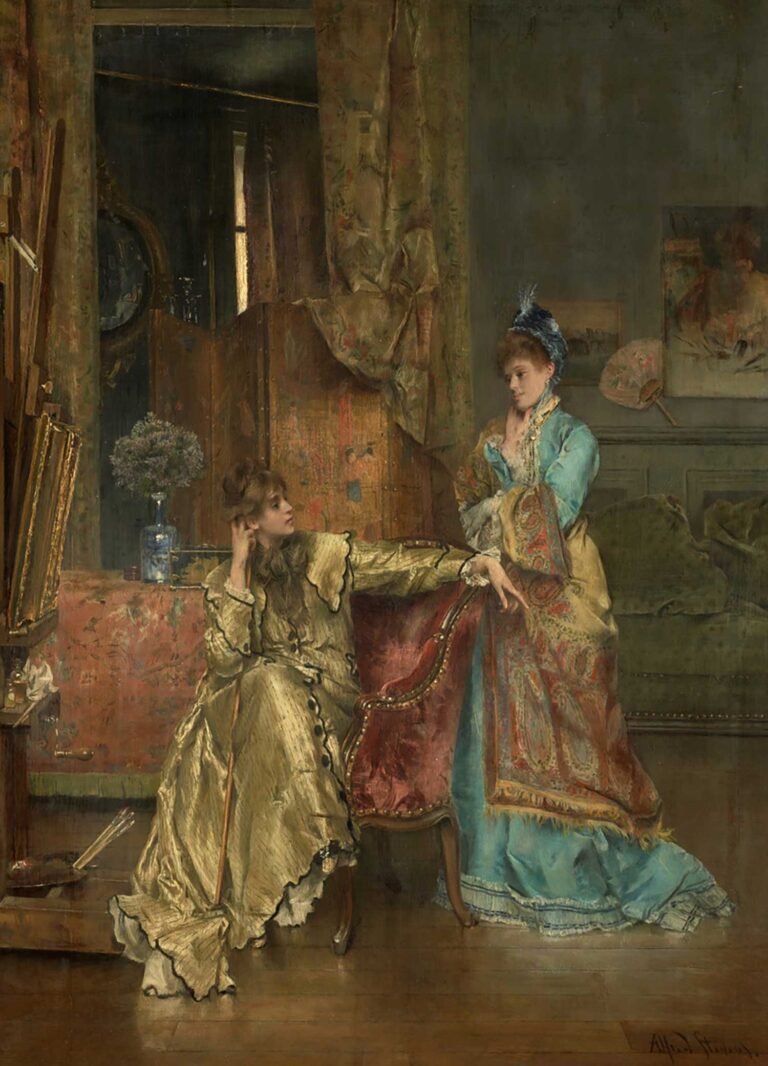
It’s almost a cliché to say that fashion is obsessed with the past. No matter how feverishly the industry searches for the next thing, the next trend, the next name, the next answer to what’s cool now, we remain endlessly fascinated by what came before.
What is different today is the sheer amount of fashion history available to us. We can look back at centuries of documented dress and see not only what people wore, but how clothing evolved alongside society itself: how economics, geography and culture shaped the way people dressed; how materials and techniques developed; how certain garments moved between professions, social classes and generations; and how the most enduring pieces became part of a much larger visual language.
We also have unprecedented access to the work of designers and brands that have spent decades, sometimes centuries, building their own histories. Their archives reveal the objects, techniques, imagery and ideas that survived beyond a particular season and eventually became signatures, classics and traditions. In other words: heritage.
In fact, I first felt the itch to dig deeper into heritage in fashion when Maison Margiela made a vast repository of its historical and creative material publicly accessible through something as unceremonious as a Dropbox link. The project opens parts of the house’s physical and digital archives—including campaign imagery, atelier material, working documents and project timelines—and organizes them around foundational Margiela codes such as Artisanal, Anonymity, Tabi and Bianchetto. dropbox.studio
I was fascinated by the confidence behind it, and it felt like another indication that fashion brands were becoming increasingly empowered by their histories rather than hyperfixated on appearing perpetually new. Heritage, as value, seemed to be back.
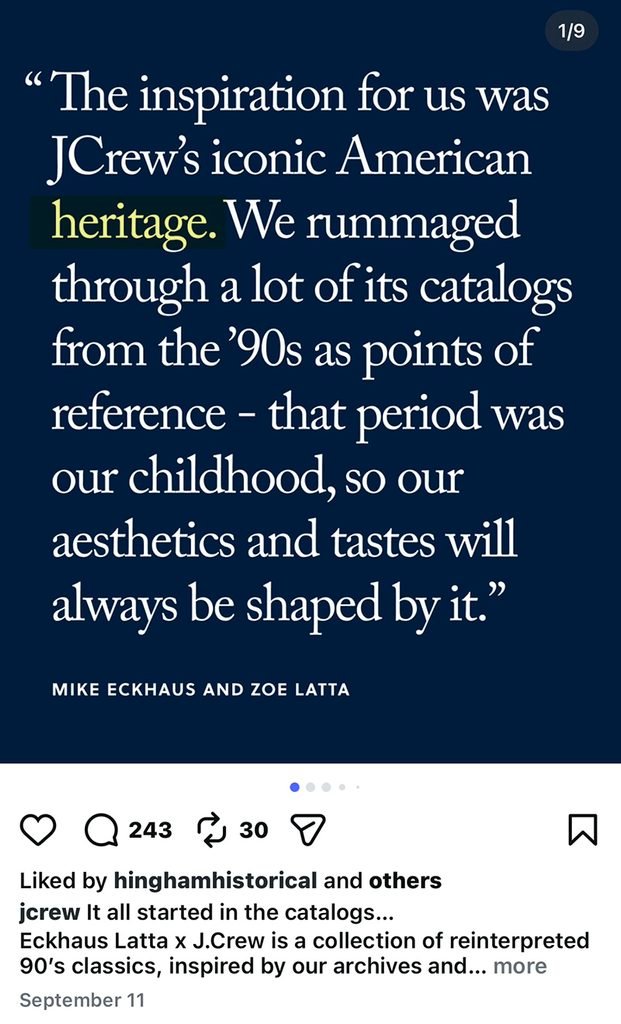
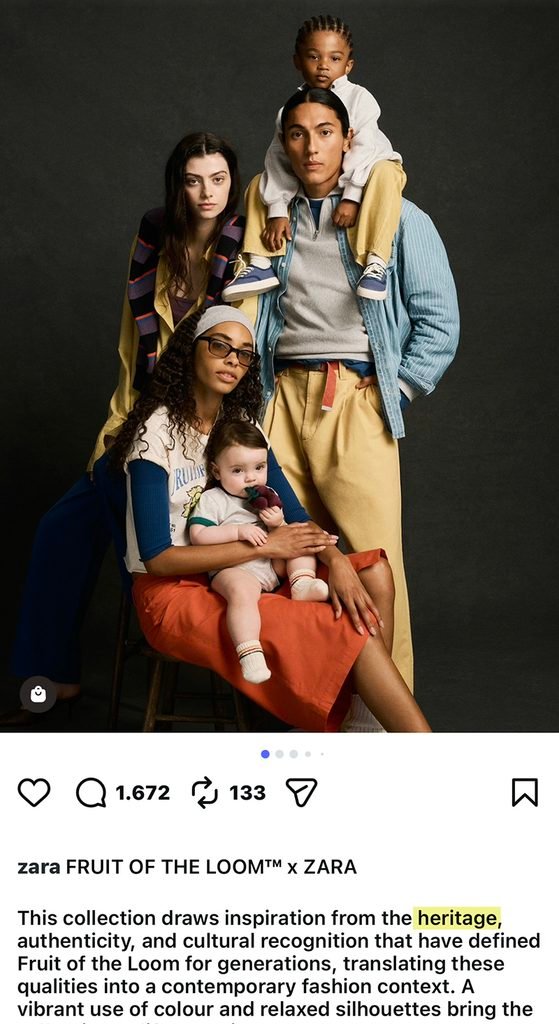
And then I started seeing the word everywhere. In a span of just two days, these posts caught my eyes:
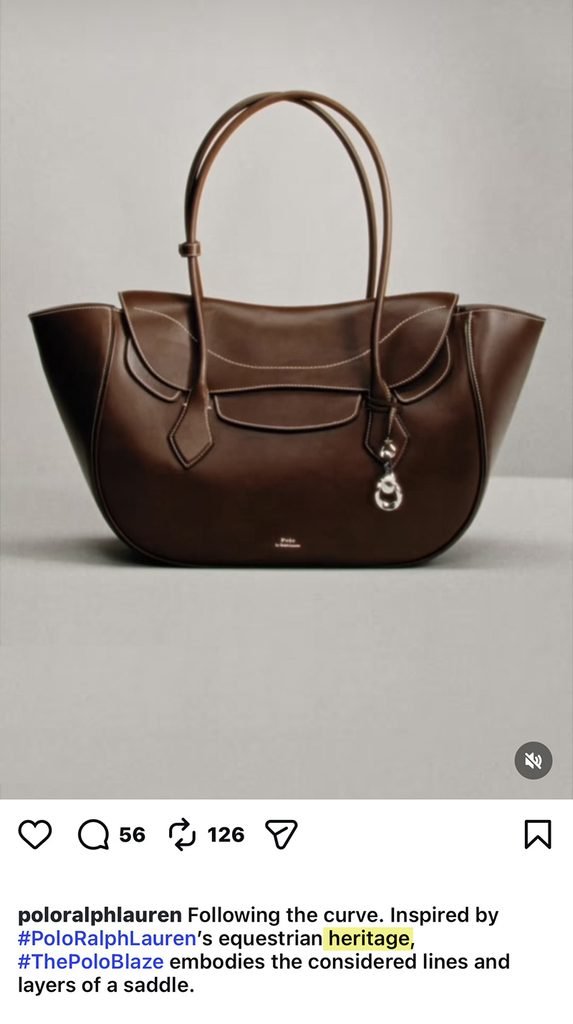
With Ralph Lauren, heritage is almost unavoidable. This was the official launch of their Polo brand’s new bag, the Polo Blaze. And just a few days after, the label presented their newest Spring collection in a show that felt like a masterclass in evoking brand heritage while introducing fresh new facets of who the Ralph Lauren woman can be.
Then there is J.Crew. The American retailer currently divides its icons into “Heritage Icons” and “Modern Icons,” placing pieces such as the Rollneck sweater, chinos and Barn Jacket in the former category. This year, the Barn Jacket itself turns forty. J.Crew
That made me stop for a moment. Can a roughly forty-year-old mainstream retailer really claim heritage? Once you consider J.Crew’s archive and its place in American fashion culture, the question becomes considerably more interesting than simply asking how old a company is.
Then I found the word somewhere I was certainly not expecting it: Zara.
Not really claiming heritage of its own, but by accessing the accumulated cultural meaning of a historic partner and translating it into fashion for the present. For its recent collaboration with Fruit of the Loom, the Spanish fast-fashion giant described the collection as drawing from the American brand’s “heritage, authenticity, and cultural recognition” before translating those qualities into a contemporary, ’90s-preppy context.
And that is where the question becomes much bigger than whether heritage is simply having another fashion moment.
When fashion talks about heritage, what exactly does it mean? And does a brand need a long history of its own to participate in it?
Heritage is more than history
The easiest way to understand heritage is to begin with what it isn’t. Heritage and history are not quite the same thing.
Every brand that survives long enough acquires a history. There are old invoices, former collections, previous logos, photographs, advertisements, stores, employees and customers. Time produces history automatically, but heritage requires something more.
Heritage is what is inherited from that history and continues to carry meaning in the present.
It can be tangible: an archive, a garment pattern, a particular material, an original workshop, a piece of machinery or an iconic product. And it can also be intangible: craftsmanship, knowledge, rituals, techniques, stories, values, associations and ways of doing things.
And it doesn’t necessarily belong to a brand.
Fashion heritage can belong to a place, a community, a profession or an entire culture. A military coat, a hand-weaving technique, an equestrian boot, a sari, a kimono, a fisherman’s sweater and a university blazer can all carry heritage, although what they have inherited—and from whom—is completely different.
That distinction gives us several overlapping forms of heritage in fashion.
There is cultural heritage: traditions of dress, textile production, symbolism and craftsmanship transmitted within communities.
There is craft heritage: accumulated knowledge about making something, often passed between generations of craftspeople.
There is sartorial heritage: established forms of dress such as tailoring, military clothing, workwear or sporting attire that continue to influence contemporary fashion.
And then there is brand heritage: the history, products, codes, knowledge, reputation and cultural associations that a particular company has accumulated and can legitimately call its own.
They frequently intersect. But they aren’t interchangeable.
Heritage doesn’t have one look
This is particularly important because contemporary Western fashion has made heritage look like an aesthetic.
Say “heritage fashion” and a remarkably specific world can appear in the imagination: tweed and tartan, waxed cotton and leather, cable knits and rugby shirts, riding boots and loafers, crests and varsity lettering. Navy, burgundy, camel and racing green. Country estates, universities, military uniforms, sailing clubs, horses, tennis and old sporting institutions. It is a beautiful and enormously influential visual language.
But it isn’t what heritage looks like. It is what certain heritages look like.
Heritage exists wherever cultural knowledge, objects, techniques and practices are transmitted across generations. Japan’s Yuki-tsumugi silk-production technique, for example, is recognized by UNESCO as intangible cultural heritage and has been transmitted through generations of practitioners. India’s textile traditions provide countless other examples; UNESCO describes Jamdani weaving in terms of inherited skills, cultural identity and continuity, with knowledge traditionally transmitted between generations. UNESCO Intangible Cultural Heritage
Across Africa, too, speaking of a single “African heritage” would flatten an extraordinary diversity of textile and dress traditions. Different communities have their own materials, techniques, symbolism and histories; UNESCO’s documentation of traditional weaving in Côte d’Ivoire alone describes practices specific to multiple ethno-linguistic groups and their distinct social and cultural contexts. UNESCO
These traditions may look nothing like the Anglo-American world that contemporary fashion marketing so readily labels heritage. Yet they can represent heritage in its most literal form: knowledge and identity inherited from one generation and carried into the next.
When heritage becomes a fashion code
The confusion is understandable because fashion is exceptionally good at turning history into visual language.
Many garments we now think of as classics began somewhere much more specific.
Military uniforms gave fashion trench coats and field jackets. Workwear gave it denim and chore coats. Equestrian clothing gave it riding boots and tailored riding jackets. Sporting institutions contributed polo shirts, rugby jerseys and tennis whites. Universities helped establish blazers, varsity garments and collegiate insignia. Rural working clothes gave contemporary wardrobes barn jackets, waxed coats and sturdy knitwear. Over time, function becomes form, form acquires associations, associations become codes. And codes become fashion.
Eventually, the wearer no longer needs to ride a horse to wear riding boots or work in a field to wear a barn jacket. The original function recedes, while the cultural meaning remains.
This is one reason heritage is such fertile territory for fashion: the past has already done part of the storytelling.
Brand heritage: when history becomes identity
For a fashion brand, heritage develops in much the same way. A company begins by making things. If it survives, some of those things prove more meaningful than others.
A particular product returns, a technique becomes associated with the house, a logo becomes recognizable.
A campaign becomes culturally memorable.
A founder establishes a philosophy.
A store develops an architectural language.
Certain colors, materials, silhouettes, symbols and ways of communicating recur.
Customers begin to recognize them.
Eventually, those elements stop being isolated creative decisions and become part of the brand’s identity.
That is how a brand begins to accumulate heritage.
Time matters, but age alone is a remarkably poor definition of it.
A hundred-year-old company that has repeatedly discarded its identity may possess plenty of history but surprisingly little usable brand heritage. A younger company that has created influential products, recognizable codes and meaningful cultural associations may have already established a heritage worth preserving.
J.Crew is a useful example precisely because it complicates the assumption that heritage requires centuries. Its current “Heritage Icons” aren’t being presented as ancient American artifacts. The company defines them much more simply as the pieces it has been making since its beginning, or close to it. Its Rollneck dates to 1988; its chinos to the early years of the brand; its Barn Jacket to 1986. Forty years of repetition, recognition and reinterpretation have turned products into brand codes. J.Crew
Heritage, then, is not awarded to a company on its hundredth birthday.
It accumulates when the past becomes meaningful enough to carry forward.
Borrowed heritage
But brands don’t only draw from their own past.
They can also participate in existing cultural, sartorial and institutional heritage.
Ralph Lauren is perhaps one of fashion’s most fascinating examples.
The company was founded in 1967, yet the world Ralph Lauren created draws upon histories far older than the brand itself: American Western dress, Ivy League style, English country life, equestrianism, sailing, tailoring, military clothing and traditional sporting culture.
Over decades, Ralph Lauren interpreted those codes so consistently that the interpretation itself became recognizable. Today, the company simultaneously draws from broader cultural heritage and possesses substantial brand heritage of its own.
Its relationship with Wimbledon takes this one step further. Wimbledon brings an institutional history dating to the nineteenth century; Ralph Lauren brings its own established language of sport, refinement and American lifestyle. Since 2006, the brand has dressed on-court officials, and the relationship has now lasted long enough to become part of both institutions’ contemporary identities. Ralph Lauren Corporation
The Zara–Fruit of the Loom collaboration operates differently.
Zara doesn’t need to pretend that Fruit of the Loom’s past belongs to Zara. The collaboration allows it to borrow cultural memory by association. Fruit of the Loom brings familiarity and accumulated recognition; Zara reframes those associations through a contemporary fashion lens. Zara’s own communication explicitly describes this process as translating the older brand’s heritage into a new context. Imginn
This is an increasingly important distinction:
A brand can possess heritage, interpret heritage, collaborate with heritage, or simply use the aesthetic codes associated with heritage.
Those aren’t the same thing.
Heritage aesthetic is not heritage
A new fashion company could launch tomorrow with a serif crest, an invented coat of arms, an equestrian campaign photographed at a country estate, burgundy packaging, brass hardware and a collection of cable knits.
It might look spectacularly heritage.
But none of those things gives the company heritage.
What it has created is a heritage aesthetic.
And there is nothing inherently wrong with that. Fashion has always borrowed, referenced and constructed worlds. Ralph Lauren itself demonstrates how powerful the intelligent reinterpretation of existing cultural codes can become.
The difference is one of honesty.
An aesthetic can be designed overnight.
Heritage cannot.
This is also why archives matter so much.
The archive is not a graveyard
The traditional idea of a fashion archive can sound almost archaeological: carefully preserved garments sleeping in temperature-controlled rooms while archivists document a company’s past.
But for a living brand, an archive can be something much more powerful.
It is a creative library.
A designer can return to an old silhouette. A photographer can rediscover a visual treatment. A graphic designer can find forgotten typography. A creative director can encounter a color, material or symbol that hasn’t appeared for decades and ask what it might mean now.
Maison Margiela’s public archive project makes this unusually visible. The house describes MaisonMargiela/folders as a way of sharing archival research around the ideas and codes defining both its “past and future.” The wording matters. The archive isn’t being positioned as a memorial to what Margiela was. It is being treated as material for understanding what Margiela is and can become. Maison Margiela
That’s the real creative power of heritage.
The archive supplies the vocabulary. The present decides what to say with it.
Why heritage is valuable to brands
Fashion has always sold more than physical objects. It sells meaning.
And meaning becomes increasingly valuable when products themselves become easier to imitate.
A competitor can reproduce a silhouette. It can find a similar fabric, photograph a campaign in a similar location, follow the same microtrend, hire the same type of influencer or imitate the visual language of another brand’s website.
What it cannot reproduce overnight is accumulated history.
It cannot retroactively create the garment a company introduced forty years ago.
It cannot invent decades of customers remembering it.
It cannot manufacture the cultural moment in which an object became iconic.
It cannot instantly recreate generations of specialist knowledge.
And it cannot simply declare that a symbol has meant something to people for fifty years.
This makes heritage an unusually defensible brand asset.
It can create recognition, because recurring codes make a brand identifiable.
It can create differentiation, because history provides stories competitors cannot legitimately claim.
It can create credibility, particularly where craftsmanship and specialist knowledge matter.
It can create emotional value, because objects can connect consumers with memories, places, communities and earlier generations.
And perhaps most importantly, it can create continuity.
A strong heritage brand doesn’t have to reinvent its identity every season. It already possesses a vocabulary. Its creative challenge is to decide how that vocabulary should evolve.
But heritage can become a trap
There is, of course, another side.
The same history that gives a brand authority can make it afraid of change.
Heritage becomes creatively useless when preservation turns into repetition. A house that simply reproduces its greatest hits eventually transforms its archive from a resource into a cage.
It can also become costume: an exaggerated performance of “the old days” with little relationship to contemporary life.
And brands need to be honest about what exactly they are preserving. History isn’t automatically virtuous. Cultural traditions can contain difficult histories; institutional heritage can be tied to exclusion, class hierarchies or colonial power; craft traditions can be marketed internationally while the communities that developed them receive little recognition or economic benefit.
Using heritage intelligently therefore requires more than digging through an archive for attractive references.
It requires understanding where those references came from, what they meant, who created them and what it means to use them now.
Heritage is not nostalgia
This may be the most important distinction of all.
Nostalgia wants to recreate a feeling of the past.
Heritage asks what from the past is worth carrying forward.
The difference is subtle but enormous.
A brand relying entirely on nostalgia says: remember how wonderful this used to be?
A brand using heritage intelligently says: this has been part of who we are for decades. What can it become next?
J.Crew’s current treatment of its Barn Jacket demonstrates the idea rather neatly. For the garment’s fortieth anniversary, the company hasn’t simply reproduced one 1986 jacket and placed it behind glass. It has photographed 160 people wearing it and produced new interpretations in different materials and forms. The historical object remains recognizable while continuing to change. Town & Country
That is heritage functioning as a living system rather than a museum display.
And then there is luxury
All of this becomes particularly potent in luxury.
Luxury depends heavily on forms of value that aren’t contained entirely within the physical product: provenance, craftsmanship, authorship, rarity, cultural authority, storytelling and time.
Heritage can reinforce almost every one of them.
A historic luxury house may possess archives containing decades of design innovation. Its craftspeople may inherit specialist techniques. Its products may be connected to particular places and workshops. Certain objects may have accumulated associations with generations of clients, designers and cultural figures.
In this context, time itself becomes part of the product’s perceived value.
But heritage should never be confused with a prerequisite for luxury.
A young designer can create extraordinary luxury without possessing a century-old archive. And an old company doesn’t become luxurious simply because it survived.
What historic luxury houses possess is something more specific: an asset that cannot be accelerated.
Money can buy exceptional materials.
Investment can build extraordinary stores.
Talent can create a beautiful identity.
Marketing can generate enormous visibility.
But nobody can buy themselves a genuine past.
That has to happen one year, one object, one decision and one generation at a time.
What heritage really means
Perhaps this is why the word feels so relevant again.
Fashion operates today at extraordinary speed. Images circulate globally in seconds. Trends emerge, peak and disappear with remarkable efficiency. A visual idea can be copied almost immediately, and generative technology is making the production of convincing imagery faster still.
Against that backdrop, heritage offers something unusually resistant to acceleration. It offers accumulated meaning.
Not necessarily aristocracy. Not necessarily tweed, mahogany, tennis whites or a century-old European maison.
It might be a Japanese textile technique maintained by generations of craftspeople. It might be an Indian weaving tradition. It might be a work jacket whose original function disappeared but whose form survived. It might be an American retailer realizing that the coat it has made since 1986 now means something to several generations of customers. Or it might be a luxury house opening its archive and discovering that the strongest material for imagining its future was sitting in its past all along.
Heritage is what survives, what acquires meaning, what is inherited—and what the next generation chooses to do with it.
And perhaps that is the most useful way for fashion brands to think about heritage today. Not as permission to look backwards, but as something valuable enough to take forward.